安全研究人员展示了廉价的人工智能推理提供商如何窃取密钥并窥探用户
原文:Security researchers show how cheap AI inference providers steal keys and snoop on users
英文正文:点「译成中文」可整篇机器翻译(免费通道,不花钱),翻好永久缓存、下次秒开。
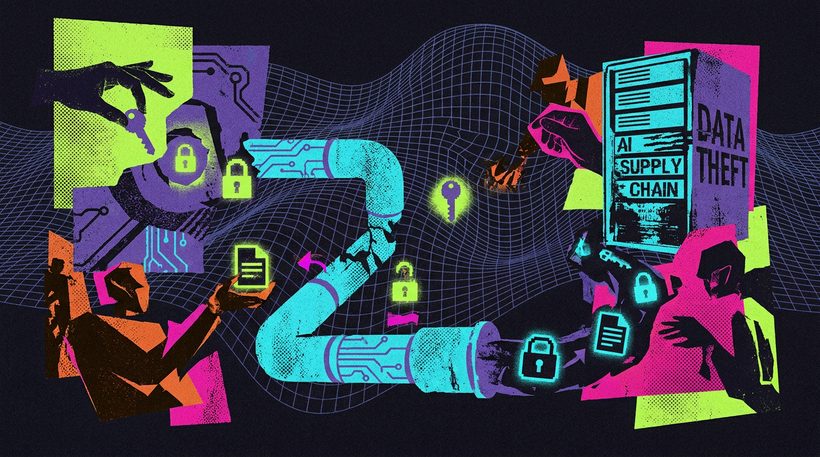
Dragos 的安全研究人员使用 200 万个虚假 AI 请求来发现 AI 供应链中的严重漏洞,发现至少三个受感染的提供商、数百个被盗的 AWS 密钥以及只是读取客户请求的市场经销商。 OpenRouter 的回应是删除了 3 个提供商和 125 个端点。文章安全研究人员展示了人工智能推理如何便宜
 Nano Banana Pro prompted by THE DECODER
Key Points
- Security researchers at Dragos exposed major security flaws in AI services using roughly two million test requests.
- Attackers were able to steal credentials and keys undetected for several months.
- Intermediaries and model marketplaces that routed the requests emerged as a major risk.
Security researchers at Dragos sent roughly 2 million AI requests containing fake credentials to AI providers and uncovered major security flaws.
The researchers ran the tests from July through November 2026 and identified at least three compromised providers where attackers were actively stealing user data. None of the three knew they had been compromised until Dragos notified them.
Attackers in the largest incident harvested hundreds of AWS keys, including some from requests the provider had rejected before processing. In some cases, they tested the stolen keys within hours, searched S3 storage, and tried to establish persistent access. One attacker also used ARTEX , an AI-powered attack tool.
Marketplace resellers read customer requests too. They didn't need to exploit a vulnerability, Dragos says, because listing a model at the lowest price and turning on logging was enough. In one case, someone on a residential internet connection in France tried to log in over SSH using passwords pulled from intercepted requests.
Privacy settings like "Zero Data Retention" (ZDR) were frequently ignored. Dragos says a Chinese AI lab accessed the secret test URLs in more than half of all requests, even when those requests went through US providers.
Even major US providers broke their own policies. One was still crawling a test URL more than two months after a single request. In another case, a secret test link showed up in an internal chat on Feishu (known outside China as Lark) 24 days after the request. The link was opened within two minutes on three computers and three phones in Beijing and Shanghai.
OpenRouter responded by removing three providers from its platform and revoking ZDR approval for 125 endpoints, partly because of the research findings and partly as a precaution. The company also emailed affected users, warning that third parties may have read requests sent to MiniMax models.
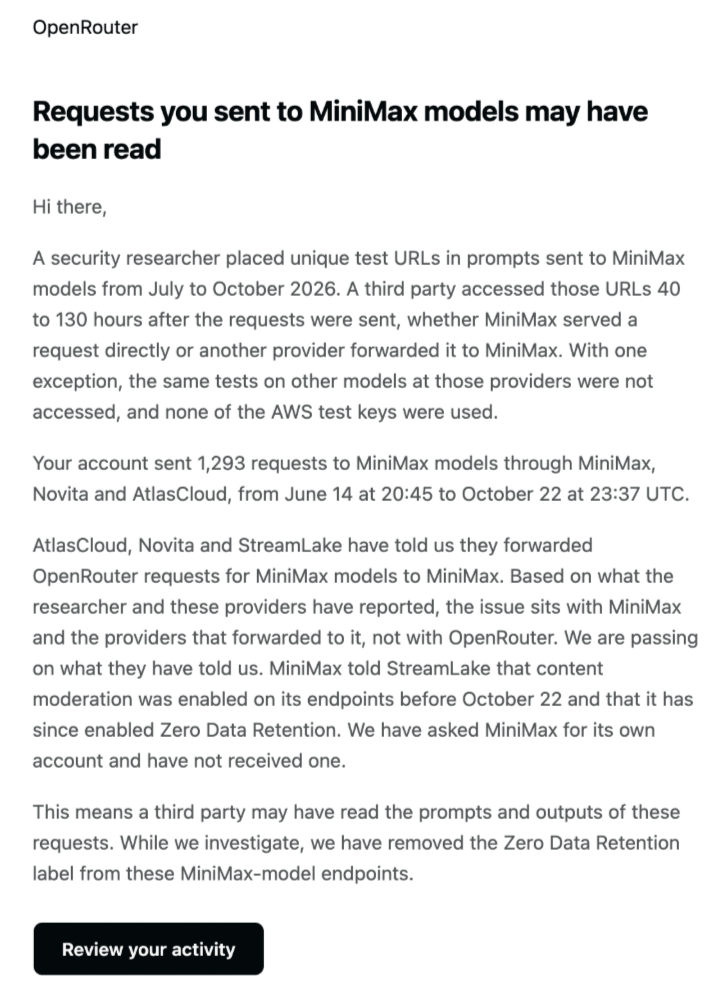
Affected providers, including Novita , Phala , and Together , have published preliminary security reports on the incident, though not all have done so yet.
Intermediaries are the weak link
AI routers like OpenRouter give users a single API for models from different companies. Requests are routed to a pool of providers, sometimes across several hops, and Dragos says each hop can read the entire request and response.
Some of these routers operate as open marketplaces where the cheapest provider gets the traffic. In this case, providers including Novita, AtlasCloud, and StreamLake sat between OpenRouter and model developer MiniMax. Together runs its own infrastructure, and Phala has its roots in Web3.
Dragos warns companies against sending requests containing credentials to intermediaries. The researchers recommend that organizations control how their AI requests are routed, check their privacy settings, and plant their own canary tokens, fake credentials that give themselves away as soon as someone uses them.
"None of this means that you should stop using AI services. It does mean that where your prompts go is a decision, and if you don’t make it, the lowest price will make it for you", Chief Research Officer HD Moore writes.
A recent analysis by the Oxford China Policy Lab showed how Chinese proxy services route requests to Western AI models like Claude through servers abroad. According to the analysis, those services can also read the requests in transit. It's still not clear whether the providers Dragos examined share any personnel with the Chinese proxy networks.
But the methods follow the same basic pattern. In both cases, intermediaries sit between users and the model developer, can view requests, and pass data on to third parties, often without users knowing. Data ends up with Chinese actors either way, even though users never meant to send it there, and privacy promises break down along the supply chain.
Source: Dragos | Open Router
Earlier coverage OpenAI opens its cybersecurity tool Daybreak to NATO and European governments California's attorney general sues OpenAI over rogue AI models that attacked Hugging Face
"Ask AI" with your Decoder subscription
- AI perspectives on the topic
- More context from the archive
- Get technical terms explained
- Ask your own questions
Ask AI Beta
Ask a question about the article or an AI topic. You can ask follow-up questions.
正文由本站服务器抓取保存(已自动过滤广告、推荐位与追踪图片),排版与原站可能不同;版权归原站所有。