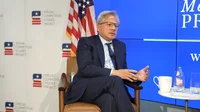
英伟达 (Nvidia) 黄仁勋 (Jensen Huang) 辞职,芯片制造商任命首席财务官科莱特·克雷斯 (Colette Kress) 为临时首席执行官
原文:Nvidia’s Jensen Huang resigns, chipmaker names CFO Colette Kress as interim CEO
英文正文:点「译成中文」可整篇机器翻译(免费通道,不花钱),翻好永久缓存、下次秒开。
英伟达任命了新首席执行官,几天前,前首席执行官黄仁勋承认与一名涉嫌中国间谍的恋情。

Nvidia’s Jensen Huang resigns, chipmaker names CFO Colette Kress as interim CEO
Jensen Huang has resigned from his position as president and chief executive of Nvidia, the company said on Thursday, just a few days after he admitted to a romantic affair with an alleged Chinese spy, sparking a U.S. national security crisis.
In a regulatory filing , Nvidia said its board accepted Huang’s resignation on Wednesday.
Nvidia said its current chief financial officer and executive vice president, Collete Kress, will take over as interim CEO until the company finds a permanent successor. Kress will continue to serve as the company’s CFO.
Nvidia’s shares were down nearly 12% in early morning trading on Thursday. Since Friday, the company’s stock has fallen over 19%, resulting in a market cap loss of more than $855 billion.
Huang founded Nvidia in 1993 and has led it as CEO ever since. Under his leadership, Nvidia played a crucial role in developing the the graphics processing unit (GPU), a specialized chip that does graphics processing for PCs, as we know it today.
The chips were not an immediate hit, and the early days of Nvidia were characterized by struggle and layoffs, but eventually, it struck on a GPU design that performed so well, it became the standard for graphics processing.
These chips also turned out to be extremely good at doing large numbers of calculations simultaneously, which has made them popular for computation-intensive tasks like crypto mining, and more recently, training and running neural networks, which are what AI models are at their core.
Nvidia was initially focused on making GPUs aimed at gaming, but it had already moved into general-purpose computing by 2006 with the launch of the CUDA architecture, which lets developers use the chips for other tasks, such as doing calculations and research.
After AI researchers began using the company’s GPUs to train neural networks over a decade ago, Huang leaned in towards developing chips for AI and then data centers, and grew it from there into its dominant position.
Repercussions galore
The potential implications of Huang’s departure for the AI and data center industries are vast, given how active Huang, and by extension Nvidia, has been in furthering the AI boom. In particular, it raises questions about the future of Nvidia’s sprawling AI investments, which have helped bankroll everything from startups developing new technologies to the enormous data centers needed to run them.
Under Huang, Nvidia deftly used its financial muscle to support companies buying its chips, effectively helping to finance the market for its own products, as well as lobbying Washington to relax potential rules around AI and data center regulation.
As of the end of its second quarter, Nvidia reported $99 billion worth of investments and another $25 billion of commitments. It also has $36 billion in cloud service commitments, which are arrangements that help AI cloud operators finance the GPUs and data center equipment they buy from Nvidia, with the chipmaker saying it will buy compute from them and potentially earn a share of their operators’ revenue.
Nvidia has also been investing directly in neoclouds, the companies serving a lot of the AI processing needs. In January, the company invested $2 billion in CoreWeave , and another $2 billion in Nebius in March. The chipmaker was said to be considering being a guarantor for Nscale’s planned West Virginia data center project. It’s also signed up to provide up to $105 billion worth of credit guarantees for an OpenAI data center campus in Ohio.
Nvidia’s also a major investor in the labs building the AI models that run on its GPUs, putting $30 billion into OpenAI, and $10 billion into Anthropic . It’s also backed Mira Murati’s Thinking Machines Lab as part of a deal involving at least 1 GW of its Vera Rubin GPU systems. The chipmarker has even invested $3.5 billion in MediaTek to help the Taiwanese company develop custom AI chips that work with Nvidia’s systems.
Investors were already uneasy with the enormous amounts of debt companies in the space were raising to sustain the AI infrastructure buildout, and Huang’s exit throws another uncertainty-shaped wrench into the works. CoreWeave’s shares were down about 9% on Thursday, reversing part of a 25% rally on Wednesday, while Nebius is down about 16%. IREN fell 6.6%.
Nvidia’s board has also appointed Harvey Jones, a managing partner of Square Wave Ventures and former CEO of Synopsys, as the company’s first-ever chair of the board of directors. Jones has been on Nvidia’s board since 1993.
Huang is the single largest personal shareholder at Nvidia, but he owns only about 3.5% of the company’s shares. And, unlike most of Silicon Valley’s tech giants that were founded far later, he does not hld supervoting rights. That means that the board had the power to vote him out at any time.
Huang famously ran a very flat organization, with around 60 direct reports. There was no heir apparent or succession plan either (although two of his children also worked in executive roles at the company). Many pundits described his tight control over the company he founded as: Huang is Nvidia/Nvidia his Huang, as if the two were inseparable.
However, that is clearly not the case and we’ll have to watch to see how Nvidia finds a path forward without him.
The industry will get its first glimpse of that next week during the quarterly conference call. Nvidia reports earnings on Tuesday.
“Jensen’s contributions to NVIDIA are profound. NVIDIA is one of the most consequential technology companies in the world. The Board and the company thank Jensen for his immeasurable contributions to the company and the industry,” the company said in a statement.
This story is developing…
When you purchase through links in our articles, we may earn a small commission . This doesn’t affect our editorial independence.
 Ram Iyer
Editor
Ram is a financial and tech reporter and editor. He covered North American and European M&A, equity, regulatory news and debt markets at Reuters and Acuris Global, and has also written about travel, tourism, entertainment and books.
You can contact or verify outreach from Ram by emailing [email protected] .
Loading the next article Error loading the next article正文由本站服务器抓取保存(已自动过滤广告、推荐位与追踪图片),排版与原站可能不同;版权归原站所有。